Tarot Learning
What Is Tarot Reading? A Beginner’s Guide
Adi · 2026-10-27
Curious about tarot, but unsure what actually happens in a reading? Tarot reading is the interpretation of card imagery and symbolism in relation to a question or situation. People use it in different ways, including spiritual exploration and personal reflection. You do not need to treat the cards as a fixed prediction to explore the perspectives they suggest.
What is in a tarot deck?
A common modern tarot deck has 78 cards. The 22 Major Arcana are often interpreted through broad life themes, while the 56 Minor Arcana explore everyday experiences. The Minor Arcana are divided into four suits: Wands, Cups, Swords and Pentacles. Each suit contains Ace through Ten, plus Page, Knight, Queen and King. Some decks use different names or imagery.
Tarot did not begin as a timeless prediction system. Historical tarot cards were used for games in fifteenth-century Italy; associations with divination developed later. Understanding this history helps separate a real cultural tradition from exaggerated claims about its origins.
What does a reading involve?
A reader may arrange cards in a spread, where each position gives a card a role in the discussion. For example, a reflective three-card spread might explore your situation, another perspective and a possible next step. This is an example, not a promise about the format of every consultation.
The reader connects the images, conventional meanings and your question. You can consider what feels relevant, what does not, and which assumptions need checking against your actual circumstances.
What can you ask?
Questions about your own choices make useful starting points: “What should I consider before making this decision?” or “What pattern am I bringing into this relationship?” These prompts create room for reflection rather than asking for certainty about something outside your control.
Tarot cannot establish another person’s private thoughts, prove that someone is being unfaithful, or guarantee a job, marriage or financial outcome. A card is not evidence. When a reading raises an idea, compare it with what you know and what you can verify.
How should you use what comes up?
Treat a reading as a conversation to think with, not an instruction to obey. Write down one insight, one question you still have and one practical action within your control. If an interpretation does not fit, it is okay to say so. You remain responsible for your decisions.
For medical, mental-health, legal or financial concerns, seek an appropriately qualified professional. Tarot should not replace treatment, specialist advice or immediate help when someone is unsafe.
Do you need experience or a strong belief?
You do not need to know card meanings before exploring a consultation. A curious but questioning approach is reasonable: ask how the reader works, what the service includes and what its limits are. There is no requirement to accept every interpretation as fact.
Explore with Adi
Mystic Light by Adi presents Tarot as a way to explore questions and perspectives, without guaranteed outcomes. If you would like a personal conversation, explore the Tarot consultation options. If you prefer to study the cards yourself, visit the Tarot course page.
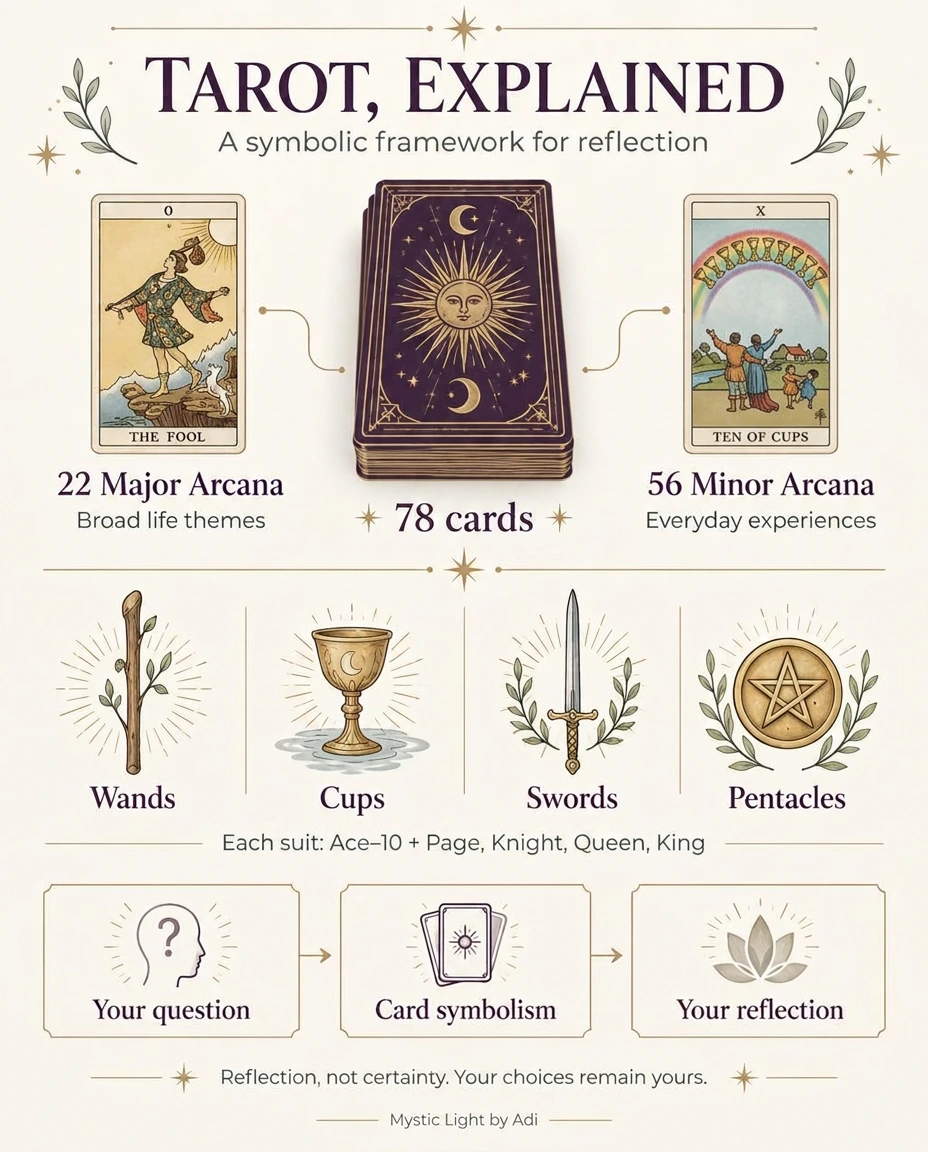
Image description: Tarot deck structure: 78 cards, 22 Major Arcana, 56 Minor Arcana, four suits, and a question-to-reflection process.