Mulank and Bhagyank
How to Calculate Mulank and Bhagyank: A Step-by-Step Guide
Adi · 2026-10-27
Mulank and Bhagyank are two birth-date numbers used in some Indian numerology traditions. They are calculated differently: Mulank uses the day you were born, while Bhagyank uses your full date of birth. This guide shows the arithmetic so you can calculate both without confusing them.
Which convention does this guide use?
Here, totals are repeatedly reduced until they are a single digit from 1 to 9. Some schools handle 11, 22 or 33 differently. If you are following a teacher or course, check that system’s rules before comparing results. A different convention does not necessarily mean someone made an arithmetic error.
Calculate Mulank: use the day only
For a birthday on the 29th, start with 29. Add the digits: 2 + 9 = 11. Reduce again: 1 + 1 = 2. Using this guide’s method, the Mulank is 2. Do not include the month or year in this calculation.
Two more examples: someone born on the 7th has Mulank 7; someone born on the 23rd calculates 2 + 3 = 5, giving Mulank 5. These are arithmetic examples, not descriptions of those people’s personalities.
Calculate Bhagyank: use the full date
Take 29 August 1994, written as 29/08/1994. Add every digit: 2 + 9 + 0 + 8 + 1 + 9 + 9 + 4 = 42. Reduce the total: 4 + 2 = 6. The Bhagyank is 6 under the single-digit method.
For this sample birthday, Mulank is 2 and Bhagyank is 6. Different results are expected because the inputs are different.
A second example to check your method
For 14 February 2001, written as 14/02/2001: Mulank is 1 + 4 = 5. For Bhagyank, add 1 + 4 + 0 + 2 + 2 + 0 + 0 + 1 = 10, then 1 + 0 = 1. The results are Mulank 5 and Bhagyank 1.
Common mistakes to avoid
-
Using the whole date for Mulank instead of just the day.
-
Leaving out the year when calculating Bhagyank.
-
Stopping at a two-digit total when your chosen method calls for reduction to 1–9.
-
Comparing a single-digit result with a master-number method without checking the convention.
Do the names mean your future is fixed?
No fixed life outcome follows from this arithmetic. Bhagyank is sometimes translated as a “destiny number,” but that is a traditional label, not proof that a number determines your future. In other numerology systems, “destiny number” may refer to a name-based calculation. Always check what a teacher means by the term.
Numerology is a symbolic practice, not a scientifically validated assessment of your abilities, compatibility or future. You can use its interpretations as reflection prompts without allowing them to decide important matters for you.
What should you do with your result?
Record your birthday, the method and the calculation. If you explore an interpretation, ask whether it connects to a specific experience rather than assuming every general statement describes you. Keep your choices, circumstances and real-world evidence in view.
Explore numerology with Adi
For a guided discussion, explore the Numerology consultation page. The free tools hub also offers separate name-number and self-discovery resources; it is not being presented here as a dedicated Mulank/Bhagyank calculator.
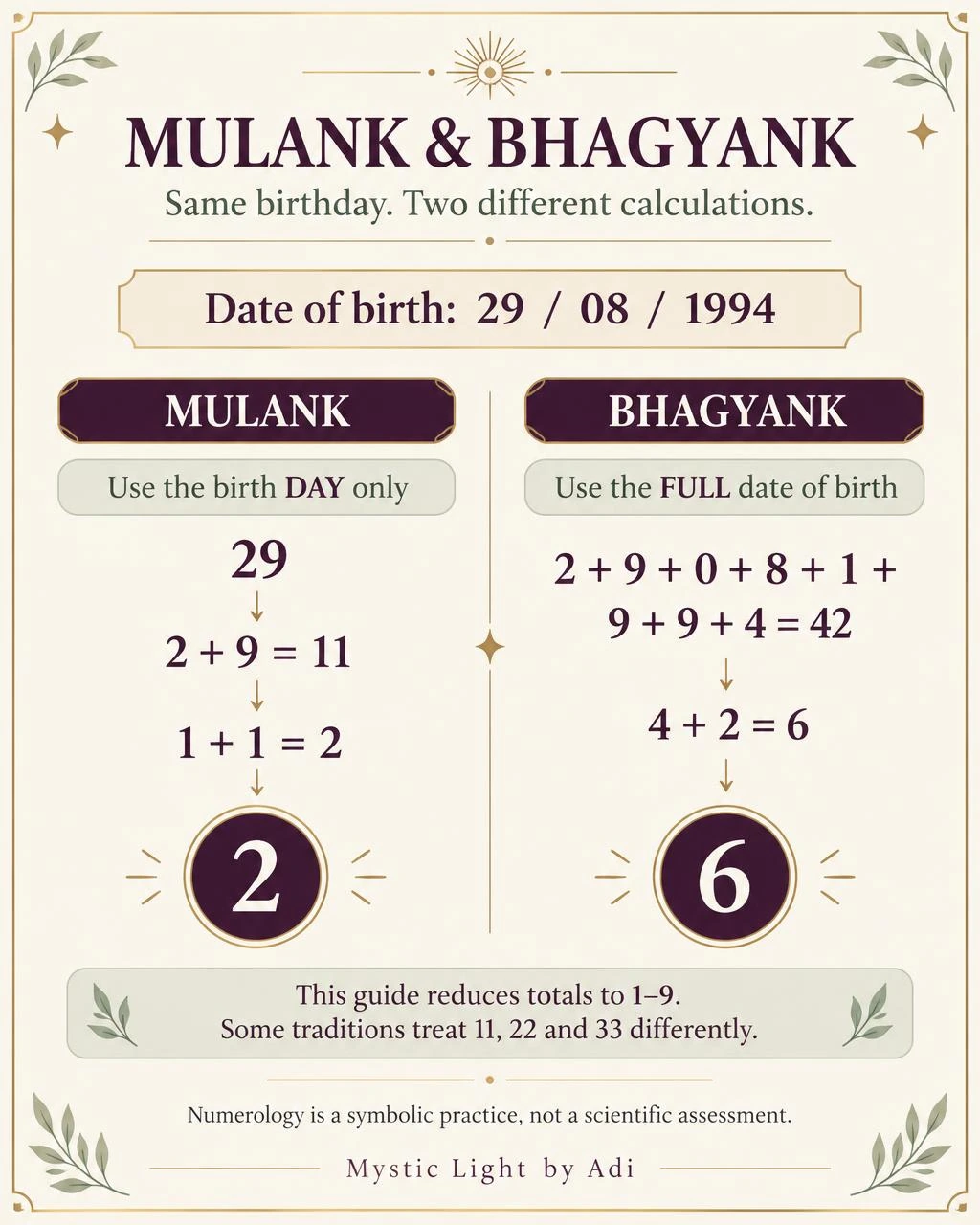
Image description: For 29 August 1994, the day 29 reduces to Mulank 2, and all birth-date digits sum to 42 and reduce to Bhagyank 6.